| ← All issues | |||||||||
| The Diff No. 040 Thursday, 12 November 2026 · AI dev news, only what is verified | |||||||||
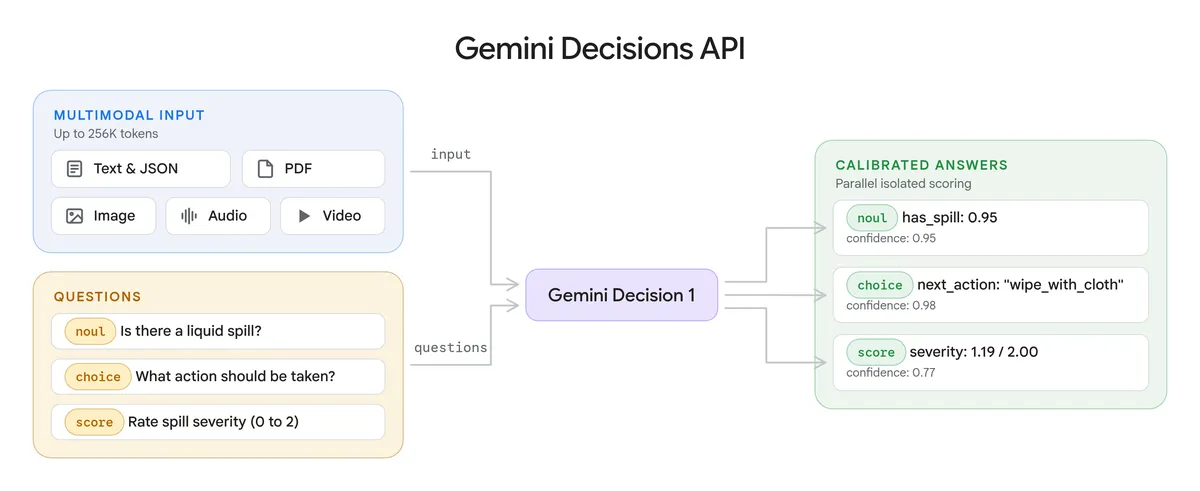 | |||||||||
Google’s newest model writes no text at all: it scores up to 1,000 questions against one input in a single pass, in about 200 ms, at $0.10 per million input tokens with output free - and Simon Willison already ran his own video through it. Plus: day five of the exposed settings files, and GitLab just shipped the defense Anthropic hasn’t. The Gemini Decisions API, powered by the new Gemini Decision 1 model, is Google’s entry in the decision-model category: bounded yes/no, choice and rubric questions over one multimodal input, probabilities and confidence scores back, no tokens generated. It sat on the Hacker News front page this morning, and LangChain and Vercel support landed on day one. Meanwhile the settings.local.json story enters day five: GitLab published a four-layer defense for group owners, push rule included, while Anthropic’s changelog - read in full this morning - remains at 2.1.322 with no fix for the file. A control-flow primitive with day-one integrations, and a security story where the platform moved before the vendor. | |||||||||
IN THIS ISSUE
| |||||||||
🔥 VIRAL The loud ones on Hacker News. Numbers are a morning snapshot. | |||||||||
01 HN thread 50456791, 321 points at 06:27 IST · Google blog, Nov 11 · LangChain + Vercel on day one 🎯 Google’s Gemini Decision 1 scores 1,000 questions in one 200 ms pass - and Simon Willison already tested itThe Decisions API answers yes/no, choice and rubric questions over one multimodal input in a single forward pass: no text generated, output tokens free. Willison’s same-day test: calibrated probabilities where rivals return hard zeros and ones. SCENE Simon Willison spent the evening passing his own stomping-robot video to Google’s newest model alongside four questions: does it have a dragon, a robot, is it set in France, in the USA. Back came probabilities, not prose: dragon 0.0498, robot 0.9234, France 0.0833, USA 0.9230. His post notes that the two rival decision models he has used, Jev and OpenAI’s, return hard 1.0 or 0.0 on yes/no questions; Gemini "insists on being a little less confident than that." THE THING The Decisions API, announced Nov 11 and powered by the new Gemini Decision 1 model (gemini-decision-1), is built for control flow: one shared input - text, image, audio, video or PDF, up to 256K tokens - plus up to 1,000 independent yes/no ("noul"), multiple-choice or rubric questions, scored in a single forward pass with no text generated. Google’s numbers: 50-100 ms of model compute, 150-250 ms end to end, nearly flat from 1 to 100 questions per request, $0.10 per million input tokens and zero output tokens billed; it also claims the lowest calibration error across its benchmark suite and "nearly 5x cheaper" than Gemini 3.5 Flash-Lite through the Interactions API - its benchmarks, its comparison. Willison’s comparisons: the API mirrors Jev down to reusing its "noul" term for a yes/no question, matches OpenAI’s GPT-6 Luna decision model on price (Jev remains cheapest at $0.042 per million), and only Gemini handles audio, video and PDFs. Google’s Philipp Schmid writes that Gemini Notebook already routes prompts across model tiers through the endpoint and Stitch applies voice edits to wireframes in real time; LangChain’s integration docs and a Vercel AI Gateway listing were live the same day. ✂️ STEAL IT Steal the split, even if you never call this API: bounded questions - which tool, does this pass policy, route where - are not generation tasks, and pricing them as generation is how you end up paying chat-model rates for a yes. If you adopt it, route on the confidence score each answer carries: high confidence fires the code path directly, low confidence escalates to a reasoning model or a human, which is how Google says Notebook uses it. Try today VERDICT A free AI Studio key is enough to replace one brittle JSON-parsing router with a single noul or choice call and measure the difference. It fails you when your questions depend on each other - they cannot see one another by design - or when you need reasons, not scores. The calibration and 5x claims are Google’s own; Willison’s test is one evening and one video. Google: the announcement · Simon Willison: same-day test · Philipp Schmid (Google): control-flow post · LangChain: integration docs | |||||||||
02 GitLab guide, Nov 11 · changelog checked 06:27 IST: 2.1.322, no fix 🔐 Day 5 of the exposed settings files: GitLab shipped the fix Anthropic hasn’t - a push rule that rejects the fileGitLab’s guide tells every group owner to block .claude/settings.local.json at push time and clean the history first. Anthropic’s changelog, read this morning, is still 2.1.322 - no fix, five days after prototypes were promised. SCENE A GitLab group owner opens Settings, Repository, push rules, and pastes one line - THE THING The guide’s logic, in GitLab’s framing: Claude Code excludes the file only through the developer’s personal global git configuration, which "stays on that laptop" and does not travel with the repository. So: add the line to each repository’s .gitignore - group file templates make every new project inherit it - then enforce with a push rule on Premium or Ultimate. Two caveats GitLab flags: the rule only inspects files being added, so existing copies and their history have to be cleaned first, and a group-level rule does not retro-apply to existing projects, so the guide ships a loop over group project IDs. It cites Apiiro’s count: 104,185 public copies of the file, 1,122 holding at least one secret. Anthropic’s side, five days after the Hacker News comments attributed to Claude Code head Boris Cherny promised to "prototype" secret scanning and better auto-mode catches: the changelog, read in full at 06:27 IST, sits at 2.1.322 - Vertex fast mode, nothing on settings.local.json or secret scanning. ✂️ STEAL IT Steal the ordering: clean first, block second. A push rule only inspects added files, so blocking before cleanup freezes the leak in history, where scanners still find it. And steal the regex even if GitLab is not your platform - the same filename check works as a pre-commit hook or a CI gate anywhere. Try today VERDICT The .gitignore line costs nothing on any tier, and the ten-minute cleanup needs no vendor. Then watch the Claude Code changelog for the actual fix: prototypes were promised Nov 7, and until one ships, the defense belongs to you and your platform - GitLab just showed what that looks like. GitLab: the guide · Claude Code changelog · HN: the original thread · VentureBeat: the response | |||||||||
📊 THE ATTENTION GAP HN points at 06:27 IST. Attention, not quality.
| |||||||||
ALSO ON THE RADAR United Airlines is banning AI agents from booking flights. United says sharing account credentials with third-party AI assistants "can expose sensitive information, and actions taken by these tools may result in unintended purchases, account changes, or use of MileagePlus miles," and argues agent check-ins could violate federal luggage-verification rules. It is restricting access on its own platforms and, indirectly, via agencies and aggregators; Kayak, Hopper and Google Flights stay. Southwest went the other way - its inventory is viewable inside ChatGPT. If your agent touches booking flows, platforms have started deciding whether it is welcome. CBS News → Fable 5.2 aces Plotly’s data exam - at 14x the price of the other perfect score. 43 of 43 on Plotly’s data-analytics bench, the third perfect score after GPT-6.1 Sol and GPT-6 Astra. The run cost $35.74, the second-priciest of 45 models on its board; GPT-6.1 Sol scored the same 43 for $2.61. Plotly’s chart puts Fable 5.2 "off the frontier." Plotly’s exam, Plotly’s numbers. Plotly → An accounting benchmark says Fable 5.2 is worse than 5.1 at finance. DualEntry’s Accounting AI Benchmark: 81.2% overall, tied 14th of 23 models, down 3.9 points from Fable 5.1’s 85.1%, with accounts receivable at 33.3% - the lowest score on the benchmark. Co-founder Benedict Dohmen: "A newer model isn’t automatically a better model for finance." DualEntry sells accounting software; the benchmark is theirs. Business Wire → Anthropic’s IPO book is reportedly oversubscribed; pricing has not landed. StockAnalysis reports the offering is multiple times oversubscribed at the $70-$78 range, citing people familiar; TradingView reports the debut could come next week. No pricing statement from Anthropic or the SEC as of this morning. StockAnalysis → | |||||||||
🧪 ONE THING TO TRY TONIGHT Ten minutes: block the file, then try the new primitive. On GitLab: add `.claude/settings.local.json` to your repository .gitignore today (free tier works), and paste the push-rule regex from story 02 if you are on Premium or Ultimate. On GitHub: turn on secret scanning and push protection, and code-search your org for settings.local.json. Then, if you maintain any router that prompts a chat model for JSON, grab a free AI Studio key and run one real routing decision through gemini-decision-1: one noul question, your actual context, and compare latency and answer against what you ship now. | |||||||||
What this issue could not see. The Hacker News comments referenced are from the account bcherny, identified as Anthropic’s head of Claude Code by VentureBeat’s reporting and Apiiro’s updated post - the quotes are the account’s words, the identification is those outlets’. GitLab’s guide, its push-rule behavior notes and its confirmation about its own infrastructure are GitLab’s. Google’s latency, calibration, benchmark-suite and 5x-cheaper claims are Google’s, from its announcement and its staff’s posts; Simon Willison’s test is one developer’s evening with one video file, his numbers as published. Plotly’s exam is Plotly’s - it sells analytics products that work with every model - and DualEntry’s benchmark is DualEntry’s, which sells accounting software. United’s quotes come from its statement as reported by CBS News. The IPO oversubscription is reporting attributed by StockAnalysis to people familiar, not a company or SEC statement. A WSJ report on Nvidia’s board and Jensen Huang is the loudest story on Hacker News this morning; it is not covered today because nothing in it is board-confirmed and primary verification could not be completed before send. VIDEO OF THE DAY is omitted for the seventh day running: no fresh, relevant and verifiable video on today’s stories - we omit rather than pad. Reddit remains absent by policy; X blocks anonymous access and was not consulted. Deduped against every published issue, No. 001-039, via the kit shipped-index and the live home archive: the Gemini Decisions API, GitLab’s guide, the United policy, and the Plotly and DualEntry benchmarks are new; the Apiiro findings were No. 036 and Anthropic’s HN response No. 039 - referenced here, not re-reported. | |||||||||
| Images: credited in each report; source screenshots and announcement artwork, not our tests. |