| ← All issues | |||||||||||||||
| The Diff No. 029 Sunday, 1 November 2026 · AI dev news, only what is verified | |||||||||||||||
 | |||||||||||||||
A single shared ChatGPT link could hand over your account, an infostealer now outsources victim triage to an LLM, and Andrej Karpathy fixed his Friday night with a two-hour build. Two stories about the application layer this morning. In one, researchers turned an ordinary public ChatGPT share link into full account takeover - a math library that never checked who was talking to it. In the other, an infostealer skips the C2 server entirely and pays an LLM by the token to decide which victims are worth robbing twice. Both are fixed or documented now; both are worth your morning. Also today: Karpathy rebuilds YouTube from HN comments in two hours, a TPU in orbit writes its first haiku, a one-binary agent that lives on any box you can SSH into, and Binance’s phased withdrawal restart. One link to rule a ChatGPT account. Plus malware with an analyst on staff, and Karpathy’s two-hour YouTube. | |||||||||||||||
IN THIS ISSUE
| |||||||||||||||
🔥 VIRAL The loud ones on Hacker News. Numbers are a morning snapshot. | |||||||||||||||
01 HN: 292 points at 06:26 IST · parameter.ai, Oct 28 · no image available 🔗 One shared ChatGPT link was enough to take over your accountParameter’s researchers chained a graph, a preview pane and a YouTube callback into JavaScript running as chatgpt.com in whoever opened the link. OpenAI fixed it in October and rated it P1. SCENE A victim receives a completely ordinary link - the kind ChatGPT produces when you click Share on a conversation. Behind that link, the attacker’s conversation contains two planted props: a genuine interactive graph, and an HTML block ChatGPT renders in its sandboxed Preview pane. When the victim opens the share, the Preview starts passing notes to the main page through the browser’s postMessage mail slot. In the researchers’ most stable version, the victim’s only action was opening the link; the alert fired about four and a half seconds later. THE THING The chain works because three defenses each assumed the others were awake. The graph loaded MathLive, a math library whose top-level message controller used an origin policy of "none" - it accepted messages from any window. MathLive let a message replace a virtual-keyboard layout with attacker HTML, joined it into a string and assigned it to innerHTML on the main chatgpt.com page, via a helper that marked it trusted instead of sanitizing it. Script tags inserted that way do not run, so the payload smuggled in an iframe with srcdoc - no sandbox attribute, so it inherited the chatgpt.com identity. The Content Security Policy still blocked inline scripts but allowed scripts from YouTube, whose oEmbed endpoint reflected an invalid JSONP callback into the response before its own validation error. The researchers say the result could enumerate a victim’s conversations, read a private chat that was never shared, and send it to an external server - full account takeover. OpenAI fixed it on October 26 and classified it P1. ✂️ STEAL IT Steal the audit question: who installed the postMessage listener in your main window, and what origin policy did it get? Every third-party widget that runs inside your authenticated page is a mail slot with a bouncer somebody forgot to hire. Try today VERDICT Read the writeup; it is a model of responsible disclosure with the exact message payloads included. It fails you as a reason to panic about old shares: OpenAI shipped the fix before publication, and the researchers’ reproduction claims are their own - impressive, but one team’s lab. | |||||||||||||||
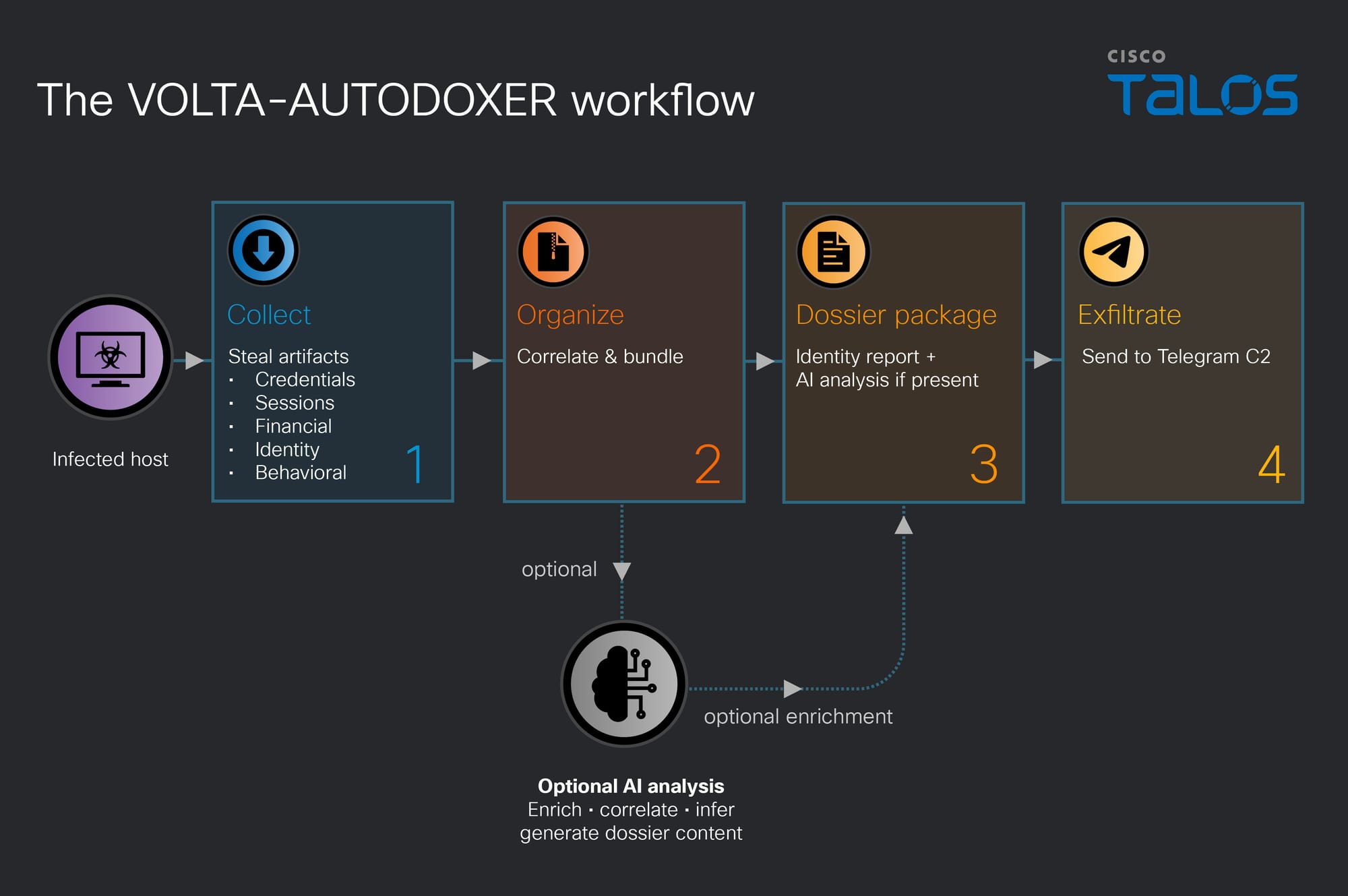 02 HN: 208 points at 06:26 IST · blog.talosintelligence.com, Oct 31 · image: Cisco Talos 🏷️ An infostealer now hires an LLM to decide what you’re worthCisco Talos documents VOLTA, a self-deleting Windows stealer that ships each victim’s dossier to OpenRouter and asks for a monetization ranking - with a fallback chain for when the model refuses. SCENE The malware economy has a triage problem: steal from a hundred thousand machines and you drown in cookie jars. VOLTA - self-named VOLTA-AUTODOXER, surfaced through the CAIRN research effort - solves it the way a growth team would. After the usual haul (browser credentials, cookies, cards, Discord and Steam sessions, SSH and cloud keys, crypto wallets cracked inline, every saved Wi-Fi password in plaintext), it builds a structured evidence bundle about the human: home address, employer, inferred birth year, card last-4, Slack workspaces, a live Roblox account valuation. Then it enriches that bundle using the victim’s own stolen sessions - searching their Gmail for purchase receipts and pulling their UberEats and DoorDash order history. THE THING The bundle goes to OpenRouter with a system prompt casting the model as "a forensic intelligence analyst drafting a target assessment," and required output sections titled "WHAT THEY’RE WORTH" - monetization ranked low, medium, high - and "THEIR OPSEC". The hardcoded default model is anthropic/claude-opus-4.6; the code checks each response for refusal phrases like "I can’t" and fails over to moonshotai/kimi-k2, then google/gemini-2.5-flash, at a deliberate temperature of 0.2. Talos’ read: the operator engineered around guardrails they expected to hit. There is no attacker-owned infrastructure - the stealer self-deletes, and the AI layer is not a traditional malware capability but "an intelligence analyst on behalf of the operator." ✂️ STEAL IT Steal the defender’s framing: your blast radius is now partly decided by how legible your life is to a model. Password reuse, receipt-filled inboxes and delivery-app histories are no longer just privacy leaks - they are scoring features. Watch VERDICT Watch whether guardrail-failover chains become standard kit; the model names here are as hardcoded in the malware, per Talos. It fails you as a prevalence number: this is one documented sample from one research effort, not a measurement of how common the technique is. | |||||||||||||||
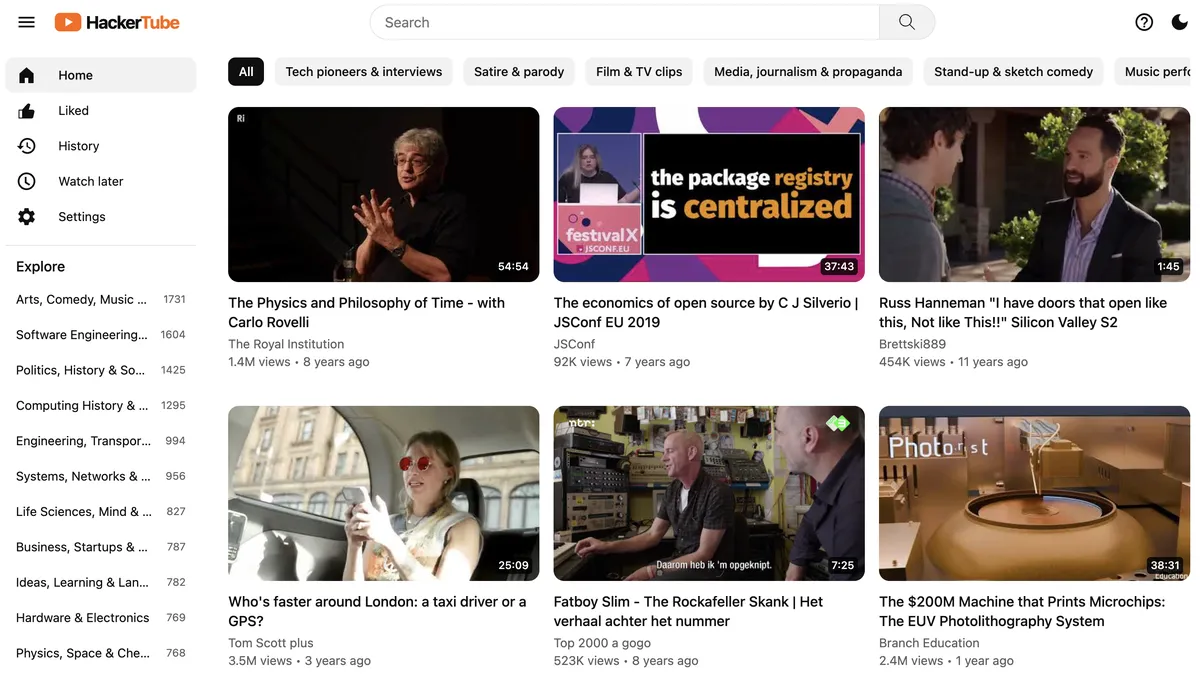
03 HN: 362 points at 06:26 IST · karpathy.bearblog.dev, Oct 31 · image: the post 📺 Karpathy looked at YouTube’s recommendations and rebuilt YouTube in two hoursHackerTube is 6,454 videos that Hacker News commenters recommended between 2007 and 2026, wrapped in a YouTube UI with no accounts and no ads - built in one Saturday morning with Opus 5.5. SCENE Friday night, 11pm: Andrej Karpathy opens YouTube and hits what he calls an "enshittified wall of slop" - exaggerated thumbnails, idiocracy-grade recommendations. Saturday morning he hands his Opus 5.5 a task: build our own YouTube from whatever videos Hacker News has ever recommended. About two hours later there is hackertube.org. THE THING The pipeline is the interesting part. Opus downloaded every HN comment, ran a Sonnet workflow over them to kill spam and low-grade content, and narrowed to 40,000 comments that recommend a YouTube video - yielding 6,454 videos across 150 topics. The product decisions are small and opinionated: thumbnails come from the 50% timestamp instead of the uploader’s choice, For You recommendations run without accounts by storing state in your local browser session, there are keyboard shortcuts, and the site’s full dataset is exportable - Karpathy’s suggestion is that you hand the export to your agent and make your own version. "This takes ~2 hours now," he notes. "I can breathe again." ✂️ STEAL IT Steal the dataset-as-product pattern: the moat here is a decade of filtered human recommendations, not the UI. If your community has a comment history, it may already contain your next directory. Try today VERDICT Browse hackertube.org and notice how different a feed feels when every video was vouched for by a person in a thread. It fails you as a YouTube replacement: 6,454 videos is a shelf, not a library, and the corpus ages with HN’s taste. | |||||||||||||||
🔭 UNDER THE RADAR Quiet tools and field reports worth your time. | |||||||||||||||
04 blog.google, Oct 30 · no image available 🛰️ A data-center TPU in orbit just wrote its first haikuGoogle’s Project Suncatcher prototype satellite answered a prompt from a ground station: Gemma 4, running on TPU trays in orbit, downlinked a haiku over Svalbard. Twin satellites are next, in 2027. SCENE On October 1, Google launched its Project Suncatcher prototype - the first step in a moonshot to power AI compute in space. Weeks of commissioning followed: powering up the host and TPU trays, running early machine-learning tests. Then, during a ground-station pass, the team uplinked a prompt to the onboard Gemma 4 open model asking for a haiku about being in space. As the satellite passed over Svalbard, Norway, the downlink came back: "Blue marble below / Data streams in silent grace / Starlight feeds my core." THE THING The haiku is the press release; the substance is the checklist around it. Google says it followed up with space-themed limericks and, more usefully, telemetry prompts reporting the technical status of payload systems. Next are thermal-stress and radiation-exposure tests - the questions that actually decide whether TPUs can work in orbit - and the 2027 milestone is a pair of interconnected satellites. Google’s framing: "Our chips have officially earned their space wings." ✂️ STEAL IT Steal the milestone design: one photogenic demo (a haiku) riding on a boring, verifiable checklist (commissioning, telemetry prompts). The demo buys attention for the checklist. Watch VERDICT Watch the thermal and radiation results - that is where space-compute economics live or die. It fails you as evidence of feasibility: every claim here is Google’s own about its own prototype, and a haiku downlink is a long way from a workload. | |||||||||||||||
05 Show HN: 35 points at 06:26 IST · github.com/guregodevo · no image available 🚪 An agent that lives on any box you can SSH into, in one binaryMemdoor is a coding and automation agent as a single static Go binary - run it locally or point it at a remote box, where it installs itself, keeps your runs alive, and lets you resume from your phone. SCENE The pitch is a deployment topology. One static binary, no Docker, no Python, Apache 2.0, macOS, Linux and Windows. Run memdoor locally, or run "memdoor --gateway ssh://you@box" and it installs itself on the box, starts its gateway there and opens the session on it. Your key stays on the box; your runs live on the box. Close the laptop, the work goes on; your phone or the next terminal opens the same conversation. Multi-step jobs are files in your repo with checks, approval gates and resume. THE THING The economics pitch is a decision model that sits in front of the chat model to route work and cut the token bill - bring your own keys via OpenRouter, Anthropic, OpenAI or Gemini. There is a GitHub Actions step that runs it on your key from CI, with nothing to add to the repo. No account is required, and telemetry is off unless you turn it on. ✂️ STEAL IT Steal the session-ownership model: the agent state lives where the compute lives, and clients attach and detach. That is tmux’s lesson applied to agents, and it is the right default for anything long-running. Try today VERDICT One curl install on a spare box is the whole evaluation; the approval gates make CI use saner than most. It fails you as a proven tool: a brand-new project with a small community, and the Show HN’s benchmark claims were not ones we could verify from the repo this morning. | |||||||||||||||
📊 THE ATTENTION GAP HN points at 06:26 IST. Attention, not quality.
| |||||||||||||||
ALSO ON THE RADAR Follow-up: Microsoft confirms the Claude Code extension incident was Cursor-marketplace-only. Microsoft Threat Intelligence’s analysis states the malicious builds "were never published nor distributed from Microsoft Visual Studio Marketplace and from npm," and that Anthropic confirmed its systems were not compromised and did not develop the package. The post adds the full five-step chain, Defender detections and IOCs. This matches No. 028’s corrected framing. The analysis → Follow-up: Northflank’s incident review took one minute. Per its published timeline, Wiz’s warning landed 11:43 UTC on October 30 and Northflank’s engineers were reviewing it one minute later; network-policy patches shipped at 12:50 and 13:05. BleepingComputer’s account of the Black October campaign cites two Wiz-investigated cases totalling roughly 2.5 million Bedrock calls and about $100,000 in fraudulent usage - a different figure than No. 028’s 800,000-call case, so treat each as its own case count until Wiz reconciles. The report → Molly, the security-hardened Signal fork, is three months unmaintained and vulnerable. A community post flags that Molly has not shipped updates while Signal’s own vulnerabilities moved on; if you run it, the post’s advice is to reassess. We could not verify version-by-version exposure from the primary this morning. The post → Jepsen takes on ParticleDB 1.1.4. A fresh Jepsen analysis, which needs no summary from us - if distributed databases are your problem, you were already going to read it. The analysis → NES Contra (1987) decompiled to C, recompiled to WebAssembly. A static recompilation path from 6502 assembly to C to WASM, playable in the browser. The demake-to-remake pipeline keeps getting cheaper. The port → | |||||||||||||||
🗂️ THE BORING STUFF Nov 1 · Binance says withdrawals resume in phases today. Per the exchange’s updates as relayed by TokenPost: phased resumption beginning with BTC, ETH and BNB, after a 90% replenishment funded from SAFU, the futures insurance fund and the corporate treasury. "Resumes" is Binance’s schedule, not an observed fact, at publication time - if you have funds there, watch the status page, not the headlines. TokenPost → Oct 31 · Northflank ships rotation tooling and audit logs for every tier. Alongside its breach response: credential rotation for PostgreSQL, MongoDB, MySQL and Redis, and audit logs enabled for all customers including free accounts. The status page remains the source of truth. Northflank status → Official pages and named outlets read this morning. Nothing installed or run; their numbers are theirs. | |||||||||||||||
🧪 ONE THING TO TRY TONIGHT Build your own front page from HackerTube’s export. Free and one evening: HackerTube publishes its full dataset - 6,454 HN-recommended videos across 150 topics - as an export precisely so you can hand it to your agent and build your own version, which is Karpathy’s explicit suggestion. The interesting exercise is not cloning the site; it is pointing the same pipeline at a community you actually belong to and seeing what its decade of recommendations adds up to. | |||||||||||||||
What this issue could not see. HN, Lobsters and GitHub were swept overnight and this morning, and primary sources were read: parameter.ai, blog.talosintelligence.com, karpathy.bearblog.dev, blog.google, github.com/guregodevo/memdoor, microsoft.com, bleepingcomputer.com, tokenpost.com, status.northflank.com, jepsen.io and piefed.world. Reddit is absent again: anonymous access from hosted networks is blocked by policy and the official app-registration route is unresolved, so no Reddit source was consulted. X blocks anonymous access; one front-page story this morning (claims about Anthropic account enforcement) had an X post as its only primary and was dropped for that reason. The ChatGPT takeover’s reproduction claims are Parameter’s own, and OpenAI has published no post-mortem - the October 26 fix and P1 rating come from the researcher’s disclosure timeline. VOLTA’s model names, prompts and fallback chain are as hardcoded in the sample Talos analyzed; its prevalence is unknown. Karpathy’s two-hour build and video counts are his account of his own project. Google’s orbital claims are Google’s. Binance’s replenishment percentage, funding sources and restart schedule are the exchange’s statements as relayed by named outlets; the phased restart was not independently observable at publication, and one low-credibility outlet claims an additional November 3 audit gate. Microsoft’s Cursor-marketplace-only scope statement is Microsoft’s confirmation. The 2.5M-call Bedrock figure and No. 028’s 800k figure come from different write-ups of the Wiz research and may count different cases. Nothing was installed or run. Deduped against every published issue, No. 001-028. | |||||||||||||||
| Images: credited in each report; source screenshots and announcement artwork, not our tests. |