| ← All issues | |||||||||||||||
| The Diff No. 022 Sunday, 25 October 2026 · AI dev news, only what is verified | |||||||||||||||
 | |||||||||||||||
Someone hid $500 of bitcoin on a server running a pre-PHP2Shell PHP and dared the internet to come take it. Overnight the security week turned into game shows and ambushes: a live bounty box pays real bitcoin to the first person who pops a deliberately vulnerable PHP server, and a researcher published a three-day audit of Tailscale with five finding classes and no vendor coordination. In the quieter corners, Dream Labs came out of stealth with $90M and a model that drives robots it has never seen, Apollo’s chief economist asked where the AI payoff is hiding, and a language designer shipped a systems language with no heap at all. Today: the bitcoin bounty, the zero-shot robot brain, two chart packs arguing about AI’s real economy, the no-heap language, the Tailscale audit, a model that thinks 39% less, and Claude Code with a video-editing skill. Show, don’t tell: a bounty, a demo grid, an audit and a benchmark table. | |||||||||||||||
IN THIS ISSUE
| |||||||||||||||
🔥 VIRAL The loud ones on Hacker News. Numbers are a morning snapshot. | |||||||||||||||
01 HN: 435 points · stealmybitcoin.com, live this morning · no image available 🪙 Steal My Bitcoin: the PHP2Shell bounty box is liveA stranger stood up a server running a PHP version from before last week’s CVE fixes, hid a wallet key worth about $500 behind a print-flag binary, and invited the internet. Nobody has claimed it. SCENE The counter on the homepage reads “0.00 hours without a successful hack” as we write this. The setup fits in a paragraph: there is a bitcoin key on this server, worth about $500, accessible to the PHP user account through the print-flag binary. The PHP version was, in the site’s own words, “selected from before the PHP2SHELL CVEs were released.” First person to get the wallet wins, and if you don’t need the money, the site nudges you toward GiveWell. All traffic is logged, and the operator warns you up front not to submit anything you want to keep private. THE THING It is the first live-fire public test of No. 019’s PHP2Shell, the CVSS 9.2 pair that dominated this week’s patch cycles. The ecosystem around that bug keeps growing: an animated explainer made the rounds overnight, and a developer’s PoC dig titled “I want my Wednesday back” asks why mass exploitation has not started yet, pointing at the best public exploit (9bie/php2shell-bypass-aslr-exp) and the friction still in it. Reuters added context of a different kind: the PHP Foundation, steward of the language, is running on one full-time staff member. ✂️ STEAL IT Steal the disclosure format: a counter, a bounty and a public log turn “how bad is it really” from a thread argument into a measured experiment. The next time your project ships a scary fix, a reproducible target with a price on it buys more signal than a hundred severity predictions. Watch VERDICT Keep an eye on the counter today; if it moves, the write-up that follows will be the real post-mortem of PHP2Shell’s practical exploitability. It fails you if you read a quiet box as proof the bug was overhyped: as the Wednesday post details, the public PoCs still have friction, and one modest target attracting hobbyists is not the internet’s PHP fleet. | |||||||||||||||
02 HN: 157 points · Dream Labs research post, Oct 24 · image: Dream Labs 🤖 Dream-1: a robot brain that skips the training montageDream Labs’ World Action Model controls bimanual robots it has never seen, on tasks it was never shown, from $3/hour. The company exits stealth with $90M in seed funding. SCENE In a test clip from Kuala Lumpur, an arm at Eastworld’s lab places an apple into a brown box. In Shenzhen, a BitRobot setup pulls a tissue from a box. In Paris, a Hugging Face robot moves a red cube into a green container. Dream Labs’ release post lists a dozen beta sites like these, each running the same model on its own hardware through the public API, with no per-robot training. The small print is worth reading too: the partner clips play at 8x speed, the in-house ones at 4x. THE THING Dream-1 is what the company calls a World Action Model: connect a new bimanual robot with parallel grippers to the API and it starts performing tasks out of the box, no fine-tuning, no demonstrations, from $3/hour. The pitch rests on two curves crossing. Hardware is collapsing in price: a capable two-arm setup now runs about $2,000, seven semi-humanoid robots sit under $15k, and Hugging Face’s $399 Microduck sold over 10,000 units in four days. And generalization is getting cheap: their February DreamZero paper, which introduced World Action Models, showed 30 minutes of data from a new robot was enough to transfer task knowledge to it. If both curves hold, robotics’ chicken-and-egg problem (no data without deployed robots, no deployed robots without usefulness) finally breaks. The company is six months old. ✂️ STEAL IT Steal the flywheel argument for any cold-start market: cheaper collection devices plus a model that generalizes across them equals a data engine that compounds. The useful question for your own domain is which half of that pair you are missing. Watch VERDICT Read the release post and study the beta-site rollouts; if you own a supported arm, the API is public and hourly, so a real test costs less than lunch. It fails you on evidence grounds today: every clip is a vendor-curated, speed-adjusted rollout, the zero-shot claims are Dream Labs’ own, and no third party has published an eval. $90M buys runway, not proof. | |||||||||||||||
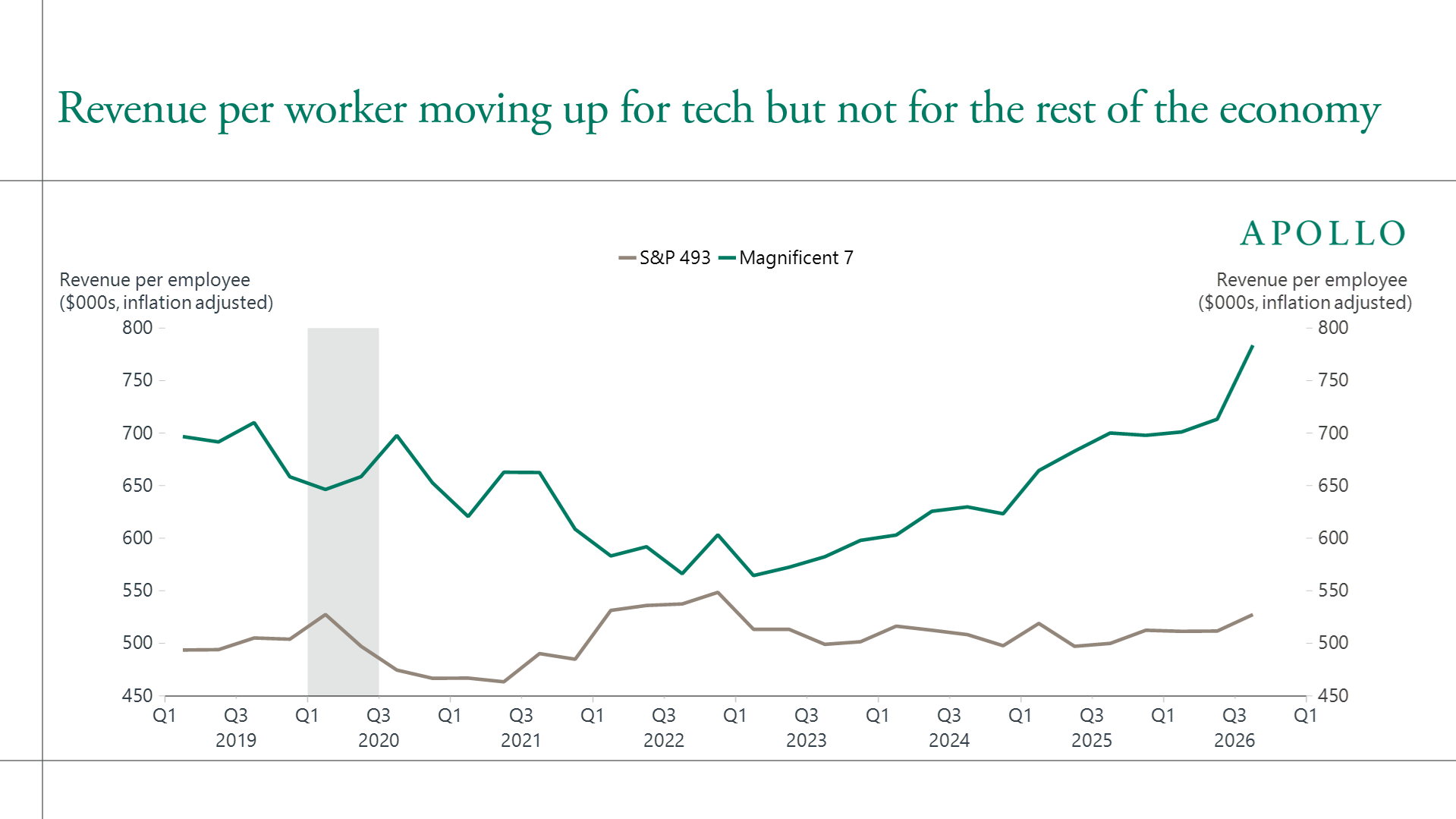 03 HN: 512 and 240 points · Apollo Daily Spark, Oct 24, and apricitas, Sep 27 · image: Apollo 📉 The AI payoff question, in two chart packsApollo’s chief economist says there is no financial payoff outside tech, full stop. A month-old apricitas essay on 200,000 lost creative-industry jobs hit the front page the same weekend. SCENE Torsten Sløk, chief economist at Apollo, opened his weekend note with a sentence you would not expect from a firm that lives off market optimism: despite massive investment and hype, AI has delivered zero financial payoff to corporate America outside of tech. His evidence is three flat lines: revenue per worker rising for the Mag 7 but flat for the S&P 493, profit margins the same, and no sign of AI in productivity growth. The same weekend, HN sent a month-old analysis by Joseph Politano to the front page: America has lost more than 200,000 jobs in media, film and the arts over four years, about 50,000 of them in the last year alone. THE THING Read as a pair, they bracket the AI-economy argument. Sløk’s side: mainstream corporate America is starting to treat token spending as a cost center rather than a growth engine, and “the AI story will be decided in the S&P 493, not the Mag 7.” His kicker is quotable: AI may be a great calculator, but in business intelligence is mostly judgment, and AI does not understand accountability, trust, culture, unwritten rules or fairness. Politano’s side: the creative-class losses are real but causally tangled, with consolidation, offshoring and the streaming squeeze in the mix. His tell: every digital subsector is shrinking while in-person entertainment keeps growing, and Hollywood alone has lost over 100,000 jobs, a third of the sector, to its lowest employment since 2008. His worst case is the newspaper precedent, an 85% payroll collapse after the internet de-bundled the business model. ✂️ STEAL IT Steal the chart split: drawing the technology sellers apart from the buyers is the general trick. The next time someone shows you an AI-adoption curve, ask whose revenue it measures. Watch VERDICT Both are chart arguments, not settled causality, and both authors say so; Sløk’s flat lines are snapshots, and Politano is explicit that AI’s exact share of the job losses cannot be proven. It fails you if you quote “zero payoff” as measured fact: it is one asset manager’s well-sourced read, and worth precisely that weight. The Apollo note · The apricitas essay · HN: Apollo · HN: apricitas | |||||||||||||||
 04 HN: 296 points · aardappel.github.io/goose · image: Goose logo 🪿 Goose: memory safety with no heap, no GC, no lifetimesWouter van Oortmerssen’s new systems language puts every dynamic value on compiler-managed data stacks. Its own benchmarks claim 3.3x idiomatic C++ at about half the memory. It compiles to one C file. SCENE The HN thread spent the night arguing about a language whose entire memory model fits in one sentence: a handful of data stacks, and scope exit is the free. Goose is the latest language from Wouter van Oortmerssen (Aardappel), and its pitch is that memory safety does not need a garbage collector, a borrow checker or lifetime annotations. The compiler proves where everything lives; the runtime tracks only bump pointers. THE THING The design is a set of interlocking constraints. At most one resizable value is live per stack and it is always on top, so growth never moves anything and never checks capacity, which is why a reference into a growing array stays valid forever, the thing C++ vector and Rust Vec cannot promise. Nested data stays inline: the demo order record with a customer string and items is 29 bytes and zero allocations, against 160 bytes and one allocation in C++ and 153 bytes and four in Rust. Threads share nothing: each worker compiles as a separate program and flat values cross typed queues as a memcpy. It compiles to a single C file, and the bundled TinyCC backend runs programs in-process with no build step. The author’s sixteen-benchmark suite claims 3.3x idiomatic C++, 1.16x hand-optimized C++ and 1.12x the best safe Rust, on 1.9x, 1.3x and 1.2x less memory. Those are his numbers on his suite; the losses are published alongside the wins. ✂️ STEAL IT Steal the constraint style: “at most one resizable value per stack, always on top” makes the fast path the only path. A system that makes the slow operation structurally impossible ages better than one that documents why you should avoid it. Try today VERDICT The tutorial, 31 sample programs and the in-process TinyCC backend mean you can be running Goose in minutes with no toolchain. It fails you if you need an ecosystem, a package manager or production hardening, and on one honest trade: arrays of variable-size elements are sequential, so you can iterate but not index them. And this Goose is not Block’s AI agent of the same name. | |||||||||||||||
🔭 UNDER THE RADAR Quiet tools and field reports worth your time. | |||||||||||||||
05 HN: 18 points, posted overnight · tailworm.com · no image available 🐛 Tailworm: a three-day audit of Tailscale, published rawErica Windisch’s crew tested tailscale v1.104.2 and headscale v0.29.5 from October 22 to 24 and dropped five finding classes, from root-through-SSH-forwarding to a crashable control server. No vendor coordination, no vendor reply yet. SCENE The report opens with a researcher’s note that reads like a dare: “we have zero-trust in our infrastructure.” Erica Windisch of Cyberdione Labs spent three days this week reproducing attacks on the current Tailscale client and the self-hosted headscale control server in a lab, then published the full assessment with a legal argument in place of a disclosure timeline: the software is BSD-3, offered without warranty, so the audit treats users as fellow developers. Tailscale Inc. had no involvement and, as of this morning, no public response. THE THING Five finding classes. The headline: Tailscale SSH’s unix-socket forwarding performs path checks and file operations as root, so races and a missing privilege drop turn one approved device plus one SSH policy rule into root execution on target servers, enrollment-key capture and arbitrary root-file deletion. Second: the experimental conn25 app connectors translate traffic to attacker-chosen destinations without consulting network ACLs, which the report maps to cloud metadata theft and Kubernetes service reach. Third: an internet-reachable headscale can be crash-looped without an account. Fourth: a malicious DERP relay can exhaust any client’s memory. Fifth: a serve TCP-forward to a unix socket can expose the node’s admin API. Their summary line: the mesh “converts one ordinary foothold into fleet-wide privileged access at machine speed.” ✂️ STEAL IT Steal the audit lens: wherever a modern mesh tool replaces a privilege-separated daemon like OpenSSH with one highly-privileged process, ask the report’s three questions: what runs as root, what does the peer get by default, and what happens when a relay turns hostile. Watch VERDICT Wait for Tailscale’s response and independent confirmation; every finding here is researcher-asserted, with no CVEs and no patches yet. It fails you as an incident runbook: there are no IOCs and no fixed versions. If you run Tailscale SSH fleet-wide, the useful weekend action is reviewing which devices hold forwarding rules, not panicking. | |||||||||||||||
 06 HN: 125 points · BottleCap AI post, Oct 23 · image: BottleCap AI 🧠 ThinkingCap teaches Gemma-4-26B to think 39% lessBottleCap’s fifth token-diet model is its first on a Google base: 38.9% fewer thinking tokens on average, up to 69.1%, for 0.15 points of accuracy. Looping drops five-fold. A drop-in vLLM swap. SCENE BottleCap AI keeps publishing the same trick on new bases: take a reasoning model, teach it to stop thinking sooner, change nothing else. The fifth ThinkingCap is their first on a Google model, gemma-4-26B-A4B-it, the sparse mixture-of-experts with 26B parameters and about 4B active per token, and they call it their cleanest result yet. THE THING The headline numbers, all from BottleCap’s own harness: 38.9% fewer thinking tokens on average across twelve benchmarks, up to 69.1% on LongBench v2, for an average accuracy cost of 0.15 percentage points, smaller than the run-to-run spread on most of the suite. Looping responses drop from 3.64% to 0.76%, truncations from 4.35% to 0.72%. The methodology section is the part worth copying: multiple seeds per benchmark, 95% intervals, and the base model measured by them rather than quoted from someone’s leaderboard. The honest blemish: AA-LCR, a long-context retrieval test, gives back 4.0 points. Same sampling settings, same vLLM stack, weights and GGUFs on Hugging Face. A PRO tier claims up to 87.6% fewer thinking tokens, their number, behind an email address. ✂️ STEAL IT Steal the evaluation axis: accuracy at a fixed thinking-token budget is the question a deployment actually asks. Their budget curve sits above the original model through the usable middle range, which is the whole argument in one plot. Try today VERDICT If you serve gemma-4-26B, this is a drop-in weights swap with GGUFs published, so a side-by-side on your own prompts is an afternoon. It fails you on long-context retrieval workloads, where the 4-point AA-LCR cost lives, and if you need independent verification: every number is BottleCap’s. | |||||||||||||||
07 GitHub: 246 stars, created Oct 23 · card: GitHub 🎬 video-editor-skills: Claude Code learns the rough cutA three-day-old skill pack teaches Anthropic’s agent first-pass video editing inside DaVinci Resolve: transcript-driven cuts, vlog pacing, B-roll. 246 stars. License not set. SCENE The repo’s pitch fits in a line: dump your footage, describe the video you want, and let Claude Code produce the rough cut in DaVinci Resolve. Not a new app, a skill pack: structured instructions that hand the agent an editor’s workflow instead of hoping it improvises one. THE THING appariciojunior/video-editor-skills teaches transcript-driven cuts, vlog pacing and B-roll placement, riding the same agent-skills wave as the security-audit skill from No. 019. Three days old, 246 stars. Two caveats before you build on it: the license field is not set, and a skill is only as good as the model’s taste on your footage. But the category is the story: “skill” is quietly becoming the unit of packaged expertise for agents. ✂️ STEAL IT Steal the pattern: write your taste-driven first-pass workflow down once (selects, pacing, structure) and let the agent run it repeatably. Editing, mixing, layout, first-pass design: anywhere you currently repeat your own judgment out loud is a skill waiting to be written. Try today VERDICT If you have DaVinci Resolve and Claude Code, one talking-head video is the entire evaluation. It fails you without Resolve, on multi-cam or color-critical work, and on the missing license for anything commercial. | |||||||||||||||
📊 THE ATTENTION GAP HN points at 06:30 IST. Attention, not quality.
| |||||||||||||||
ALSO ON THE RADAR eMudhra: the deadline passed, and the regulator’s own site is revoked. No. 020’s CA compromise keeps compounding. Mozilla’s root-program bug sits at NeedInfo on eMudhra after it let the investigation deadline pass; India’s MeitY called the coverage social-media fear mongering; and captnemo’s scan now counts 1,377 Indian government domains on revoked eMudhra certificates, 811 still serving them, including the Controller of Certifying Authorities, eMudhra’s own regulator. Firefox refuses the sites via CRLite; Chrome loads them fine. Nemo’s scan → Your phone, your rules: a lockdown countdown against a banking thaw. keepandroidopen.org is counting down about 70 days to the first enforcement wave of Google’s developer-verification program: from 2027, apps on certified devices need central registration with fee, ID and signing-key proof, which F-Droid calls existential. Counter-signal: about a dozen banking apps, historically hostile to GrapheneOS, just began explicitly permitting it. 530 and 628 HN points. Keep Android Open → Roku moves its developer repos from GitHub to GitLab. The streaming company’s developer blog explains the move; 272 HN points of platform-loyalty discourse followed. Roku developer blog → The PHP Foundation runs on one full-time staff member. Reuters reports the steward of the language that powers much of the web is “under-funded”, per its own director. Context for the week its flagship bug became a game show. Reuters → | |||||||||||||||
📺 VIDEO OF THE DAY  New Language Claims to Be as Safe as Rust, but Faster and Simpler Code to the Moon · published Oct 21, four days before this issue · 175,523 views at 06:30 IST · 10 minutes · description read, not watched A 10-minute tour of today’s report 04: Goose’s origins, its most notable features, what the channel wants on its roadmap, and a closing argument for why programming languages still matter in the AI age. It is the most-watched Goose video we could find, and it predates this week’s HN wave by a few days, which usually means a calmer take. Title, channel, date, length and view count verified this morning via YouTube’s page metadata; we read the metadata and description but did not watch, so treat this as a pointer, not a review. | |||||||||||||||
🗂️ THE BORING STUFF Oct 23 · OBS Studio 33.0.0 ships. A big under-the-hood release: the CEF framework behind browser sources and docks jumps from the July 2024 build to September 2026. GitHub Releases → Oct 23 · Turn notifications into code with Copilot in Teams. The new GitHub app in Teams lets you @mention GitHub on a notification and get back a pull request. GitHub Changelog → Oct 23 · Enterprise installations for GitHub Apps GA. GitHub Apps can now be installed at the enterprise level, generally available. GitHub Changelog → Official pages read this morning. Nothing installed or run; their numbers are theirs. | |||||||||||||||
🧪 ONE THING TO TRY TONIGHT Take the $500 dare. Open stealmybitcoin.com, read the one-paragraph setup, and if you have the skills, have at it: it is a legal, invited bounty on a deliberately vulnerable box. No exploit chops? Run php -v on anything you operate and check it against the fixed versions from No. 019. Either way, the counter on the homepage will tell you how the internet is doing. | |||||||||||||||
What this issue could not see. HN, Lobsters, GitHub’s search and APIs and YouTube page metadata were swept, and the primary sources were read: stealmybitcoin.com, the Dream Labs research post, the Apollo Daily Spark note, the apricitas essay, the Goose language site, the tailworm.com report, the BottleCap AI post, the Mozilla root-program bug, captnemo’s scan, keepandroidopen.org, the Roku developer blog, the OBS 33.0.0 release notes and two GitHub changelog items. Reddit’s LocalLLaMA and MachineLearning RSS endpoints rate-limited or refused every overnight and morning check (alternating 429 and 403), so Reddit coverage is effectively absent today. X mirrors returned no usable data, Bluesky refuses anonymous API reads, LinkedIn is a login wall and r/programming blocks RSS. The Tailworm findings are researcher-asserted, with no vendor response at publication time; benchmark and view numbers are author or vendor claims as labeled. YouTube was read via metadata, not watched. Nothing was installed or run. Deduped against every published issue: Steal My Bitcoin and the PHP Foundation item follow No. 019’s PHP2Shell coverage, and the eMudhra items follow No. 020; Dream-1, the Apollo and apricitas pair, Goose, Tailworm, ThinkingCap and video-editor-skills are all new. | |||||||||||||||
| Images: credited in each report; source screenshots and announcement artwork, not our tests. |